Implants provide a strong foundation for fixed (permanent) or removable replacement teeth. Dental implants are a long-lasting replacement for teeth which look, feel and function like natural teeth.
Here at Buckden Dental Clinic, our team works in conjunction with Dentsply Astra, which is the world leader in dental implants. The Astra Tech Implant System with ‘German Engineering’ is a well-documented system that has been in clinical use for 30 years, offering outstanding results and success rates.
Dental implants are made of titanium and have an internal screw called an abutment that holds a false tooth (or teeth) in place. The dental implant process involves the’ titanium screw’ being inserted into the jawbone. Once the bone attaches firmly to the implant (osseointegration), a replacement tooth is secured to the top of the implant.
Dental implants replace one or more teeth without affecting adjacent teeth. Dental implants can support a bridge and eliminate the need for a removable partial denture.
We can also offer implants, which provide support for a denture, making it more secure and comfortable.
Book an Appointment

The first step your dentist will do is a full assessment to check your suitability for treatment. This will include a thorough evaluation, including X-rays, to assess your jawbone. Your dentist will also discuss alternative options for you, such as bridges and dentures. Your dentist will be able to give you a preliminary estimate for the treatment. To be able to check if your jawbone is suitable for implants, your dentist will need to take a 3D scan. We will be able to discuss the scan with you and go through what the procedure entails.
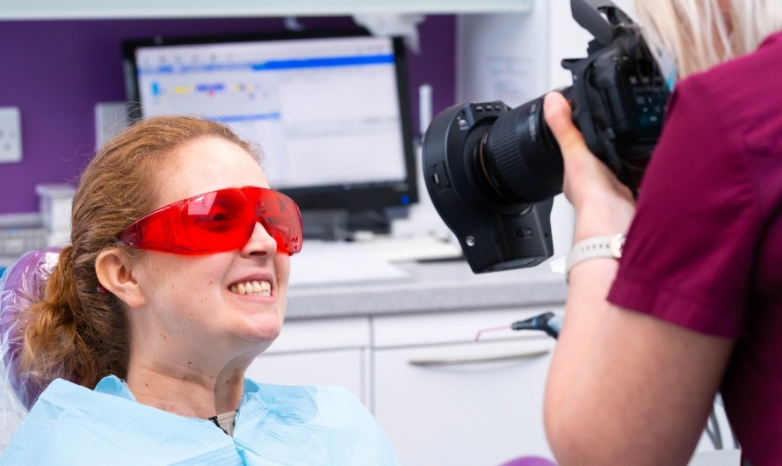
The next process is to take some initial records of your teeth as a ‘before treatment’ clinical record. This involves clinical photographs and either a scan or impressions of your teeth. This is often completed by one of our qualified nursing team members. Your dentist will review all the records again with you in depth. You will be given a full written consent and treatment estimate. You will have plenty of time to ask any questions you may have.
The next stage is placing the implant. This is completed under local anaesthetic, the same as you would for a filling. A small incision is made in your gum to access the bone underneath. There will be some drilling and water whilst the jawbone is being prepared for the implant. The implant is placed with a cover screw over the top to protect it. The gum is then sutured back into place. The surgery itself doesn’t take very long, around 30-40 minutes. You shouldn’t feel any pain, but you may be slightly sore and swollen afterwards. We’ll supply you with an aftercare pack with painkillers and instructions on keeping the area clean.
We’ll review you a week or so later and remove any sutures still remaining. We’ll leave the area for at least three months for the implant to integrate into the jawbone.
After about three months, we’ll bring you back to ‘uncover’ the implant. We’ll give you some local anaesthetic and use a dental laser to remove the gum above the implant. We use a laser instead of a scalpel as it stops any bleeding as we go, resulting in faster healing. Once the top of the implant is accessed, the cover screw is removed and a larger healing abutment is placed. This will be visible in your mouth through the gum. This will ensure the gum heals and shapes nicely, ready for the final ‘tooth’ or crown on top.
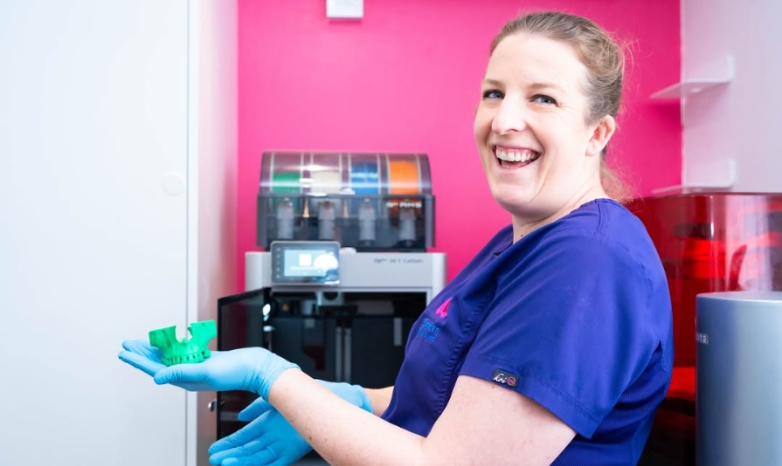
After about six weeks, we’ll start the process of attaching your final ‘tooth’ or crown to the implant. To do this, we’ll remove the healing abutment and place another type of abutment, which we will either take an impression and send to the laboratory to make your final crown, or we may be able to scan using our CAD CAM CEREC machine and mill your crown on site at the practice and fit it the same day!

“I don’t normally do reviews, well, not good ones anyway, but on this occasion I will. Having neglected my teeth for over 7 years due…
“I had the best experience I’ve ever had at a dentist at Buckden Dental Clinic. The staff are all wonderful, from the receptionists to the…
“We were recommended Buckden Dental Clinic and are so glad we were. We recently joined Buckden Dental Clinic after moving to the area and being…
“I have the utmost confidence that any dental work advised by Kam. I have been a patient of Kam for almost two years. During that…
“The hygienist today is the best one I have ever been to. I just wanted to tell you the hygienist today is the best one…
Am I suitable for dental implants?

To be suitable for dental implants, you do need to be in good general health and have excellent oral health. If you require other dental treatment, such as fillings, we will recommend that you have these done first. You will need adequate bone in your jaw to support the implant.
We will take a 3D scan of your jaw as part of the assessment process to evaluate your bone levels. The implant can be ‘virtually’ placed and planned using the 3D software, so we know exactly the implant procedure before we even pick up an instrument!
Sometimes deformities in the jaw can leave you with inadequate bone in which to place dental implants. We can use a bone substitute to correct the problem and build up the missing jawbone. We can do this with a mixture of synthetic bone and your own blood plasma (L-PRF) to get great results and faster healing.
What are the advantages of dental implants?
There are many advantages to dental implants, including improved appearance. Dental implants look and feel like your own teeth, and because they are designed to fuse with bone, they become permanent. Other advantages include:
How do I care for my dental implants?
It is important to keep your dental implants clean from plaque and prevent peri-implantitis. Peri-implantitis is inflammation in the gums around implants. It is caused by bacteria from plaque that builds up along the gum line.
If plaque is not removed, it soon turns into hard tartar, and over time, the bone around the implant will start to break down. If left untreated, the implant will become loose and fall out.
Depending on whether the implants are for a single tooth, a bridge or supporting a denture, you may need a special brush to reach where the implant meets the gums. Your dentist or hygienist will help you with this.
Use interdental brushes or specialist floss to reach the sides of the implants and in between the adjacent teeth. Use a single tufted brush to clean around the small implant posts under a denture.
What can I expect after treatment?
Dental implants are like your own teeth and will require the same care with a good oral hygiene routine. In order to keep your implant clean and plaque-free, brushing and flossing still apply. After treatment, your dentist will advise the correct care plan for you. Periodic follow-up visits will be scheduled to monitor your implant, teeth and gums to make sure they are healthy. You will need to attend the hygienist regularly.

 Follow us on Instagram