When it comes to replacing missing natural teeth, dentures are a reliable and time-tested option.

Dentures

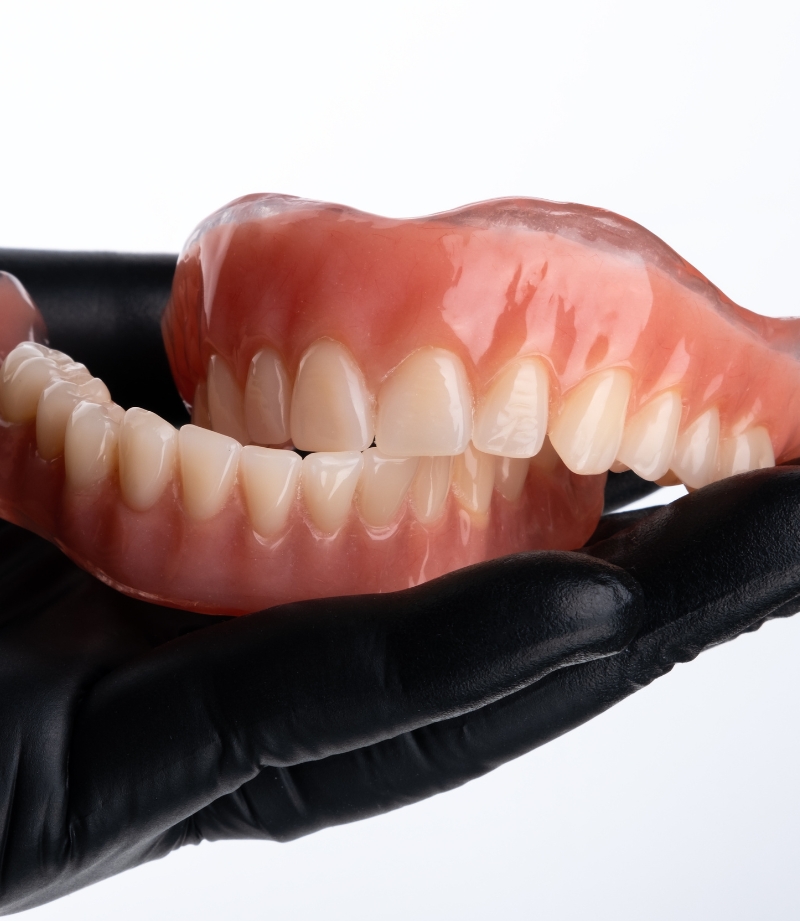
Dentures are removable appliances which are used for replacing one or more missing natural teeth.

Book an Appointment
down white purple circle arrow down white purple circle arrow

GET IN TOUCH

Get started with us

Treatment

How are dentures prepared?

The process for the fabrication of dentures is performed in multiple steps, and it usually involves more than one appointment. First, your dentist will examine your teeth to determine the types of dentures which will be suitable for you. Next, your dentist will make an impression or scan of your teeth and send it to the laboratory.

At the next appointment, your dentist will record the position where your upper and lower jaws meet. Afterwards, the artificial teeth are added to the denture plate in the laboratory. In the next visit, your dentist will perform a try-in of your denture in which the teeth are embedded in wax. If everything goes well, you will get your brand-new dentures at the next appointment.

To maintain a proper fit over time, it may be necessary to adjust your denture or possibly remake your denture. Never attempt to adjust a denture yourself, and do not use denture adhesives for a prolonged period because they can contribute to bone loss. When in doubt, consult your dentist.


Dentures
line gray plain shape

Why you should remove your dentures at night

Give your gums time to rest and stay healthy

Unless you have had a denture fitted on the same day as you have had teeth taken out, your dentist will recommend that you remove your denture each night. Research has shown that removing the denture for at least eight hours during either the day or night allows the gum tissue to rest and allows normal stimulation and cleansing by the tongue and saliva. This promotes better long-term health of the gums.
Dentures
line gray plain shape

Denture care

Cleaning instructions:

  • Brush with warm soapy water and a denture brush. Clean over a sink-full of water to reduce the risk of dropping and breaking it.
  • Never use harsh, abrasive cleansers, including abrasive toothpastes, because they may scratch the surface of the denture.
  • If you wear a partial denture, be sure to remove it before brushing your natural teeth.
  • Leave your denture in a sterilising solution according to the manufacturer’s instructions (some are safe for overnight, others only a few hours).
  • Only a small amount of denture fixative is required – a small dot in three points on the fitting surface of the denture.
  • A whole tube should last 6 weeks; any quicker and you’re probably using too much. The less you use, the better the results to form a stable fit; too much will lift the denture off the ridge and make it feel too bulky.

logo pink red plain symbol

“I don’t normally do reviews, well, not good ones anyway, but on this occasion I will. Having neglected my teeth for over 7 years due…

Alan B

logo pink red plain symbol

“I had the best experience I’ve ever had at a dentist at Buckden Dental Clinic. The staff are all wonderful, from the receptionists to the…

Amie C

logo pink red plain symbol

“We were recommended Buckden Dental Clinic and are so glad we were. We recently joined Buckden Dental Clinic after moving to the area and being…

Rachel

logo pink red plain symbol

“I have the utmost confidence that any dental work advised by Kam. I have been a patient of Kam for almost two years. During that…

T.F.W

logo pink red plain symbol

“The hygienist today is the best one I have ever been to. I just wanted to tell you the hygienist today is the best one…

Wendy C

View All Reviews

Frequently asked questions

down purple white circle arrow What are the different types of dentures? down purple white circle arrow right purple white circle arrow

There are different types of dentures depending on their design and the number of teeth replaced.

  • Partial dentures – These dentures are used for replacing only a few missing teeth in a jaw. They are either made from metal alloys or from polymeric acrylic resins. The removable partial dentures contain metallic extensions known as the clasps, which engage the crown portion of adjacent healthy teeth and prevent the denture from dislodging. Partial dentures rely on the underlying jawbone, oral soft tissues and neighbouring healthy teeth for their support and retention.
  • Cobalt chrome dentures – These dentures tend to be more comfortable and stable than acrylic dentures. However, due to the metal frame, they are less aesthetically pleasing. Chrome dentures require support from your remaining teeth to hold the denture in place. This can cause extra stress and wear on those teeth over time.
  • Flexible dentures – These dentures are made of a nylon fibre impregnated with resin. These dentures are often much more aesthetically pleasing and less plastic than other denture materials. Flexible dentures can be used to replace single teeth with a small, clip-like denture or multiple areas.
  • Complete dentures – As the name suggests, these dentures are used when there are no teeth left in a jaw, or when the remaining teeth need to be extracted before preparing the dentures. Since there is no tooth remaining in the jaw, complete dentures rely solely on the oral soft tissues and jawbone for their retention and stability. Dentists sometimes use an adhesive to improve the retention of complete dentures.
  • Implant-supported dentures – These are also known as implant-supported overdentures. These dentures rest directly on a dental implant, unlike conventional dentures and therefore, possess superior strength, durability, and aesthetics. A benefit of implant-supported overdentures is that only one implant can be used for replacing up to 3 or 4 adjacent missing teeth. Your mouth will continue to change as the bone under your denture shrinks or recedes.

instagram instagram Follow us on Instagram

View on Instagram
4.9
Google-review